Showing posts with label creativity. Show all posts

Wednesday, March 26, 2025

Of Time and Space

That sounds a little like I'm going to delve into Einstein's theory of relativity, but I'm not qualified for that so I'm keeping it simple.

Recently, a friend mentioned making space in her life for a creative project. Although I've heard that expression, it resonated with me like it hasn't before, and I realized that I've been too focused on "making time" in my life. 

We can't make time. We can manage it, allocate it, save it, fritter it away, but there's only so much of it to go around. And honestly, I have enough time to accomplish what I want to accomplish, so I should have no excuses, right?

But mentally and creatively, I haven't made the space. Thinking of it that way feels like a huge shift in perspective for me right now. Space opens up room for possibility. And possibility makes way for probability.

I'm hoping Einstein (seen here in a portrait from the Museum of Illusion in Chicago) would agree.

Enjoy the last week of March. See you next month!


Wednesday, September 11, 2024

Weekly Roundup 35: Pollination

From the linden tree that blooms in the spring to the summer's bee balm to the last sunflower of autumn, I have a fair number of bees buzzing around my yard all season. I'm not a master gardener, but I steer clear of pesticides and in general try to have a suitable oasis where the bees can get about their business of pollination.

In very simple terms, pollination is the transfer of pollen within and between flowers, which allows for fertilization and production of the plant's fruit or seed. Bees, birds, bats, butterflies, beetles, moths, and even the wind are part of the process. It is so critical to food production, from large-scale agriculture to small garden plots like mine, that the State of Colorado passed legislation this year to protect pollinating insects and their habitats. 

So, for many plants, nothing comes to fruition without pollination.

Bear with me as I try tie this in to writing.

I have a partially completed manuscript I've been trying to get back to for months. When people ask me if I'm writing, I think about that neglected WIP and feel guilty when I say, no, not really, I'm on a bit of a hiatus right now, been busy with other things, I'm stuck, etc. (All these things are true, by the way, but not great excuses.)  

I'm so grateful for people who care about me and my writing. And it occurred to me the other day that every time someone asks me, it's almost as if...here it comes...each question is like a friendly bee buzzing around me, pollinating my creativity, doing its part to nudge me closer to fruition.

Too much of a stretch? Probably.   

But I think it's working.  

A big thank you to all the literal and metaphorical pollinators in my life! See you all next week.


Thursday, October 28, 2021

Get Your Monster Mash On

Hello all! We're nearing the end of  the month, and I'll be sorry to see October go. We've had the most gorgeous weather, which will either make it easier or more difficult when the first snow arrives!

My sister belongs to a choir in Seattle, and last year they did this socially-distanced version of Monster Mash. I hope it helps you get in the *spirit* for Halloween :-)


And I also hope you have more treats than tricks


With some scares thrown in, if that's your thing!


For anyone who doesn't know this bit of Colorado lore, The Stanley Hotel in nearby Estes Park, CO was the inspiration for the Overlook Hotel in The Shining. Find out more in this segment from the Today Show 2018. Happy haunting!

Monday, April 13, 2020

A to Z Joy: Kinetic Art

Hello and welcome to another week of A to Z! I hope you're all staying safe, healthy, and sane!

I'm not an art expert, but I did a little Googling and discovered that the origins of kinetic art go back to the late 19th century Impressionists, such as Monet and Degas, who accentuated the apparent movement of human figures on canvas. This idea continued through op-art and surrealism, where the eye is given the illusion of movement.

But the kinetic art that brings me joy are the three-dimensional pieces--usually mobiles or sculptures--that move either naturally or by motor. American artist Alexander Calder is famous for his mobiles, this one charmingly titled Big Fat Banana:

Alexander Calder | Big Fat Banana, 1969. Metal and paint (18… | Flickr
On a much larger scale, American sculptor Jonathan Borofsky's Hammering Man sculptures in Seattle, Washington, USA; Seoul, South Korea; and Frankfurt, Germany, celebrate working men and women all over the world.

Hammering Man - Seattle, WA | TMAB2003 | Flickr

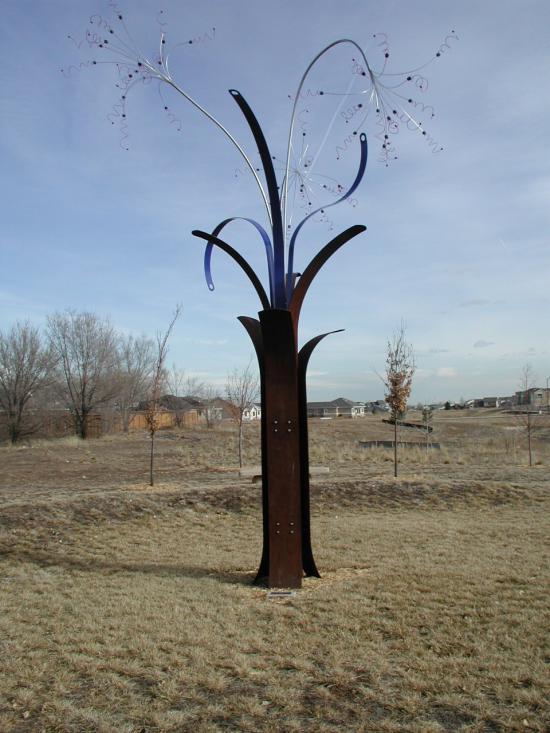
At a park near my house stands this whimsical sculpture called Secret Garden (1999), by artist Gunnar Anderson.

Secret Garden

From his artist's statement:
I believe each person's Secret Garden is to be found in their own heart. I imagine this garden to be peaceful, joyous, bigger than life and so real that once visited it will never be forgotten. My hope is that this sculpture in this special place will help inspire a stroll through your own Secret Garden.
I took a short video the other day when the wind was blowing. I hope it gives a sense of this whimsical piece.


Wednesday, March 11, 2020

The Reveal

This post was supposed to happen last week, but sometimes even small projects take me longer than they should. Anyway, here I am with the reveal: I painted one wall of my office space and swapped the large desk with hutch for the smaller desk that was in my bedroom. Oh, and I got a new lamp.

Before:


After:


Color choice is really hard for me, probably because I know I'm bad at it. After lots of thought, I decided on yellow, because my writing space is in the basement and doesn't get a lot of sunlight. I wanted something that would pop--you know, that whole energy/joy thing. In the end, I chose a color called Geographic Yellow. I assume it's a reference to National Geographic, which brought thoughts of travel and adventure to mind. When I got it on the wall, however, it reminded me more of macaroni and cheese. (The perfect color for a Kraft room, ha ha.) 

I didn't love it at first, but it's been almost two weeks now, and I think the color is growing on me. It certainly does liven up the wall! And the big desk looks much better in its new home, so I guess this project is an overall improvement. Whether the change jump-starts my creativity is yet to be determined. Fingers crossed!

If you missed my first installment of Local Joys, pop on over to my other blog and check it out!


Wednesday, March 27, 2019

The Pen is Mellower Than the Sword


Image result for chinese calligraphy symbols and meanings(Hello, last Wednesday of March. Where did you come from??) As part of my resolution-making way back in January, I decided I would learn a new skill this year. For some reason, my brain settled on calligraphy. I don't really know why, except that I do love writing with a nice pen on nice paper. Not long after that, I was poking around in Barnes and Noble and came across Suvana Lin's Chinese Calligraphy Workbook: 50 Characters to Inspire PEACE and CALM. (Yes, capitalized and everything, so you know it must be true.) 


I had thought I would start with Ye Olde English Calligraphy. But I was intrigued by the idea of inspiring peace and/or calm, and Lin's book is pretty to look at and very straightforward. A few key points about the process:
Image result for chinese calligraphy symbols and meanings
"Center."

  • China's earliest form of written communication is oracle shell writing, which dates back approximately 3,500 years.
  • The Chinese consider calligraphy to be a regimen to calm the mind and nurture the heart.
  • Traditional calligraphers make their own ink by grinding an ink stick in water on an ink stone or slab. This has the additional benefit of warming up the hand and wrist.
  • The preferred paper is Xuan paper, made of 40-80% elm bark.
  • Each character belongs to a "radical," which is like a root. The radical for waterfall, for example, is water.
  • The 8 basic strokes are always done in order.

I'm sorry to report that I did not grind my own ink. Instead, I used a brush marker I picked up from the craft store. The book includes plenty of practice space, so I didn't feel the need to track down the special elm bark paper, either. Each day, I practiced for at least fifteen minutes. As advised in the book, I started with the easiest character: one--a single, straight horizontal line. In addition to representing the number one, it also means "only," "single-minded," "special," and "unique." 

Over the course of the week, I grew fairly comfortable tracing even the more elaborate characters but was less successful winging it on blank paper. I usually got close enough, though, that someone who knows could probably recognize what I was getting at--the same way I can read a teenage boy's messy penmanship. Because I was pretty focused on trying to do it right, I didn't achieve much peace or calm. But with practice, it seems entirely likely. There is something very meditative about completing the correct strokes in the correct order, with the result being both beautiful and meaningful.

There are plenty of characters in the book for me to continue to learn and practice, so this one is a Take It.

 
Please don't grade my work


Wednesday, February 27, 2019

When TED Talks, People Listen


Image result for ted talk
This TED...
Hello and happy Wednesday! Considering the adversarial, and often downright ugly, tone of the news these days, it's easy to forget that the world is full of people who know and do interesting things and are willing to share them with the rest of us. I reminded myself of this last week when I decided to watch a daily TED talk.

Image result for Bill and Ted's Quotes
Not this Ted.

If you are unfamiliar with TED, here's what the website says about their organization:
TED is a nonprofit devoted to spreading ideas, usually in the form of short, powerful talks (18 minutes or less). TED began in 1984 as a conference where Technology, Entertainment and Design converged, and today covers almost all topics — from science to business to global issues — in more than 100 languages. Meanwhile, independently run TEDx events help share ideas in communities around the world.
TED has also expanded to include the TED Radio Hour, TED Masterclasses, the TED mobile app, and TED-ED animations, which are short, fun videos that use fun graphics and music to explain a variety of science and lifestyle topics.

Other than catching snippets of the TED Radio Hour in my car, I've been in a TED-free zone for quite some time. It's one of those things I tell myself I should do more of--"Hey, self, you should watch more TED talks!"--but then I never actually do it. So I was grateful for my Take It or Leave It kick in the pants, because I really enjoyed my daily dose of TED.

I learned, among other things, about the physics of bubbles, the science behind human organ regeneration, and how dog noses work. I was inspired to re-think my personal narrative and persevere in the face of failure. I got some tips on how to get better at the things that really matter to me. I listened to a guy talk about how he tried something new every 30 days, which confirmed to me that small changes in our lives are much more sustainable. Last but not least, I watched a semi-compelling animation about why humans should eat more insects. (Bugs look much more appetizing in cartoon form, I must say.)

Image result for Best Ted Quotes

Many of the TED talks are quite short, and there was no need to devote hours and hours to broadening my world view. But once I got started, it was easy to just keep watching. All in all, this week of TED has been one of my favorite new activities, which makes this Take It or Leave It a definite Take It.


Wednesday, January 23, 2019

The Sound of One (Non-dominant) Hand Clapping


Hello! Welcome to Week 3 of my Take It or Leave It Challenge.
When my mom was a little girl, her older sister taught her to write left-handed. But in elementary school, her teachers determined that she might be more comfortable being right-handed. As a result, she's still ambidextrous enough to write with both hands. That's the cool part. The downside is that she's had lifelong confusion about which hand she should use. 


Image result for Funny ClappingI have no such problem. If my brain needs something done, it knows to ask Righty. For all intents and purposes, Lefty is just there for symmetry. But I've heard for years that it's good for the brain to call upon the non-dominant hand to help with routine tasks. In fact, ambidexterity training is a thing now, and its proponents claim such benefits as improved neuroplasticity, increased creativity, better memory, less stress, more positive mood... (The other side to the story is research showing that ambidextrous people tend to perform more poorly on certain cognitive tests and may have greater age-related decline in brain volume. Yikes!)

Out of curiosity, I thought I'd try ambidexterity myself. For the last week, I've been calling upon Lefty to help me out with everyday activities: brushing teeth, brushing hair, opening doors, vacuuming, cooking, eating, and the like. Frankly, the results were mixed. First of all, it was really hard to change my ways. I'd be halfway finished with something before I remembered to switch hands. I also learned that there are certain tasks I can't trust Lefty to do. Cutting, for example, with knives or scissors. Anything to do with my contact lenses/eyes. And the hairdryer was fine, but even though I only use a curling iron for smoothing out bed head, Lefty just couldn't manage it. Afraid to go to work with random facial burns, I quickly gave that one up.

To cap off the week, I did the Sunday crossword left-handed, the result being something between a third-grader's homework and a ransom note.

I didn't feel any more creative or less stressed--the opposite, really--but the exercise did present many deep, philosophical questions, such as: Why is there toothpaste on the mirror? Why is my belt on backwards? Who spilled coffee grounds all over the floor? All in all, I'm not a convert to this opposite-hand business, with one exception. Using my non-dominant hand for eating slowed me down and made me much more thoughtful, which is a good thing.

For Take It or Leave It, this one's mostly a Leave It.


Wednesday, September 5, 2018

All Hail the Mother Log

A month or so ago, I had the pleasure of visiting Northern California's redwood forests for the first time. The giant trees were all I had hoped for and more. As my family and I hiked around in the cool green shade well below the canopy, I felt as if I could be in another world. It seemed impossible that wildfires raged out of control less than a hundred miles away.

In the forest we also saw streams and ferns and banana slugs. And my younger son introduced me to the concept of a mother log, also known as a nurse log. (I prefer the former, so that is the term I will use.) A mother log is a fallen tree, which, through its inevitable decay, helps nurture the next generation of seedlings, as well as a whole ecosystem of plants, insects, and small animals.

The mother log collects water and provides a soft blanket of moss. It shares nutrients with new growth and, depending on where and how it fell, provides access to direct sunlight--a scarce, but necessary, commodity in a dense forest. There is also evidence that a mother log can offer resistance to pathogens. The decaying process may take hundreds of years, during which time the mother log actually contains more living matter than it did when it was alive and upright. It's such a fascinating transformation that in 2006, an artist in Seattle built a greenhouse around a rotting tree and thus turned it into an art installation. (It's called the Neukom Vivarium.)

We all have plans and ideas that fall flat. Sometimes quietly, and sometimes with a resounding crash that shakes the ground beneath us. It can be disappointing and unsettling. Even devastating. All that time and effort, all those resources, feel wasted. But what if we could look at these events not as failures but as a necessary part of the process for ensuring future growth? That brilliant endeavor which toppled so spectacularly might give rise to many more that will eventually take their place in the sun.

I have no trouble imagining potential failure. I have a harder time imagining the potential in failure. But I'm learning that even though it may be hard to see, it's still there. Just like the thousands of microbes, seeds, fungi, beetles, millipedes, and spores waiting to turn a fallen tree into a cradle full of future possibilities.


Thursday, March 8, 2018

Repeat After Me

Last weekend, I had a couple of kitchen misfires (which is not at all unusual for me). First, I used a new gluten free flour blend for Swedish pancakes and ended up with a gummy mess. Then, I used a different shape of pan for my favorite coconut cake, and the result was...well, let's call it a sunken treasure.

Image result for picasso paintings"You should never change anything," said my dear husband. "You need a repeatable process."

I get that. I do. Especially coming from someone who has spent his whole career in a manufacturing industry...and has a favorite menu item in every restaurant because that way, he's never disappointed.

But I also firmly believe that if we don't ever make changes to a process, it can lead to stagnation, complacency, and a false confidence that we are doing everything right and have no need for improvement.

The internet abounds with articles and theories about creativity--what kind of thinking it requires, what situations support it, whether it can be learned or is innate. For me, everyday creativity isn't necessarily about a big new idea, though those are wonderful and exciting. It's about that extra nudge when my brain asks me, "Is this the best you can do?"

Sometimes, the answer is yes. In that case, my brain accepts that I am lazy, and, with an awkward parting glance, we move on to other things. Other times, I accept the challenge and try to stretch myself a little. The results are not always amazing, but I feel satisfied that at least I peeked around an unfamiliar corner to glimpse what waited there.

So, we need both: the framework of the repeatable process and the wiggle room to take a few chances within it. As Picasso said, "Learn the rules like a pro so you can break them like an artist."

Great advice, but I don't think I'll try to find out if it applies to Swedish pancakes.