Saturday, April 7, 2018

G: Gremlins

I know gremlins are not obscure. Most of us have heard of the mischievous little fellas, the movie of the same name (1984), and even the AMC car produced in the 1970s. (One of my elementary school teachers drove a Gremlin, and I thought it was the most awesome car I had ever seen. Hey, it was the '70s, people.)

Image result for gremlin car

I always assumed that the gremlins of legend had a long and storied past, similar to brownies, sprites, and leprechauns. But the gremlin origin story dates back only to the 1920s, when Royal Air Force pilots invented the concept to assign responsibility for otherwise inexplicable aircraft malfunctions. (The term gremlin is thought to be a portmanteau of Grimm's Fairy Tales and Fremlin Beer.) Some returning airmen even swore that they had seen tiny creatures sabotaging their equipment. Historian Marlin Bressi suggested that gremlins boosted morale by providing a means for deflecting blame. Move over, scapegoat, here comes the scapegremlin!

Image result for gremlin war poster 


Well before he wrote Charlie and the Chocolate Factory, author Roald Dahl is credited with introducing gremlins into popular culture. He had served in the RAF and survived a crash landing in the Middle East (Caused by gremlins, perhaps? The world may never know.). In his first children's novel, The Gremlins, the title characters were little men who lived in clouds and hangars and ate...postage stamps...?

And who can forget the 1963 Twilight Zone episode, "Nightmare at 20,000 Feet", starring William Shatner and a gremlin who wears only slightly more eyeliner?

Related image

Here's hoping you stay safe from the gremlins today, my friends! 


Friday, April 6, 2018

F: Febold Feboldson


A Swedish-American plainsman from Nebraska, Febold is an American folk hero who could influence the weather as a cloudbuster/rainmaker. In one tale, he hypnotized frogs into croaking so loudly that a) the clouds thought it was thunder and began raining, or, depending on the version, b) the Native American rain god got a headache from all the noise and sent rain to shut the frogs up.

Febold is often in the same class as Pecos Bill and Paul Bunyan, American heroes of lore who are perhaps not actually based on true folk tales but rather "invented" by writers. In the 1950s, this practice resulted in the coining of the term fakelore, meaning manufactured folklore presented as if genuinely traditional. But stories are fluid and change over time, and it can be difficult to draw absolute lines around them. So now, you're more likely to see the term folklorism in reference to the adaptation, or outright invention, of folklore.


Thursday, April 5, 2018

E: Ekkekko


(also Ekeko, Ekako, Eq'eq'o)

In the Andean highlands of Bolivia, Ekkekko is the domestic god of fortune, wealth, and plenty. He is portrayed as a small, jolly man with a pot belly who is covered with household utensils. According to legend, if you place a small object on an Ekkekko doll, you will receive what you wish for in the coming year. Miniatures are sold at market fairs in his honor, and Ekkekko amulets and charms are worn for good luck.

I have to say, from his hat to his sandals, he exudes a pretty happy vibe!
 

Wednesday, April 4, 2018

D: Dendan

Image result for dandan sea creature

(also spelled Dandan)

In Arabic legend, the dendan is a monstrous fish--large enough to swallow an entire ship in a single gulp--who nonetheless dies if it hears a human voice. It makes an appearance in Book 9 of The Thousand and One Nights, in the tale of "Abdullah the Fisherman and Abdullah the Merman." The two Abdullahs meet when the fisherman catches the merman in his net. They somehow become business partners and eventually decide they should hang out for a while at the merman's home. Fat from the dendan is made into an ointment, which the fisherman uses to cover his body so he can breathe under water. As the two Abdullas are enjoying a feast together, a dendan comes swimming along. The fisherman shouts at it, and sure enough, it dies instantly. I'm sure that was a great relief to the merman, who had no such powers of...what exactly would that be called? Lethal monster voice?

The dendan/dandan also makes an appearance in the Magic: The Gathering card game, in the Arabian Nights expansion pack.


Tuesday, April 3, 2018

C: Cat Maiden


In this Aesop's fable, a cat fell in love with a young man, who in turn thought of her as, well, a cat. So she asked Venus for help. Being a good sport, and also the goddess of love and beauty, Venus turned the cat into a fair maiden. The young man was immediately smitten and wanted to marry her before she could even set up a Match profile. Upon further reflection, Venus began to wonder if the cat's nature had changed, or just its appearance. To find out--and because gods and goddesses were always messing with the poor, dumb humans--Venus let a mouse loose at the couple's wedding. (I'm pretty sure etiquette experts frown on this sort of thing.) The cat-maiden pounced on it, which grossed her new husband out to no end. Having found her answer, Venus turned the young woman back into a cat. The moral of this story being, true nature always wins out.


Monday, April 2, 2018

B: Bumba


In the African mythology of the Congo's Bushong people, Bumba was the creator god. He lived alone, and very lonely, in a universe of water until one day, after extreme stomach distress, he vomited up the sun, moon, and stars. The sun dried up the water, so Bumba then vomited eight animals: leopard, crested eagle, crocodile, fish, tortoise, heron, beetle, and goat. These animals went on to create many other animals. Finally, Bumba barfed out mankind and gave them laws, customs, and rulers. When Bumba was done with all this, he returned to his home in the sky. But he will occasionally visit mankind in dreams and visions.

(On what I assume is a completely unrelated note, when my firstborn was young, he named his beloved stuffed cat Bumba.)

Thanks for stopping by. Hope to "C" you tomorrow!


Sunday, April 1, 2018

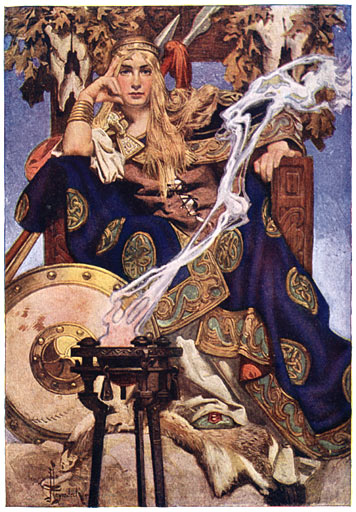
A: Aengus og

See the source image 

If you're Irish, this one might be familiar to you. In Celtic mythology, Aengus og  is the golden-harped god of love and beauty. Conceived and born in one day, he is described as attractive in both his looks and his nature. His kisses became invisible birds that whispered thoughts of love into the ears of young men and women. He drank the Ale of Immortality (bonus A for today!) brewed by Goibhniu, the god of the smith, which probably accounts for his eternal youthfulness. (Is it just me, or are the love gods/goddesses always young? I call ageism! Another A!) When Aengus traveled, four swans circled over him, which would have made it hard to sneak around without being noticed, I imagine.

Have a great day, and listen closely for those whispered thoughts of love...

See you tomorrow!